

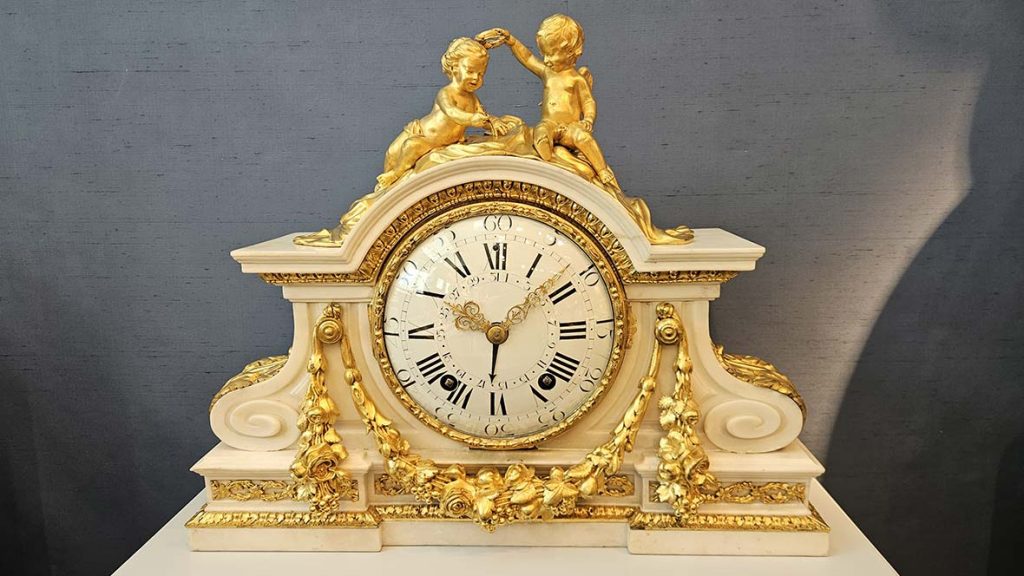
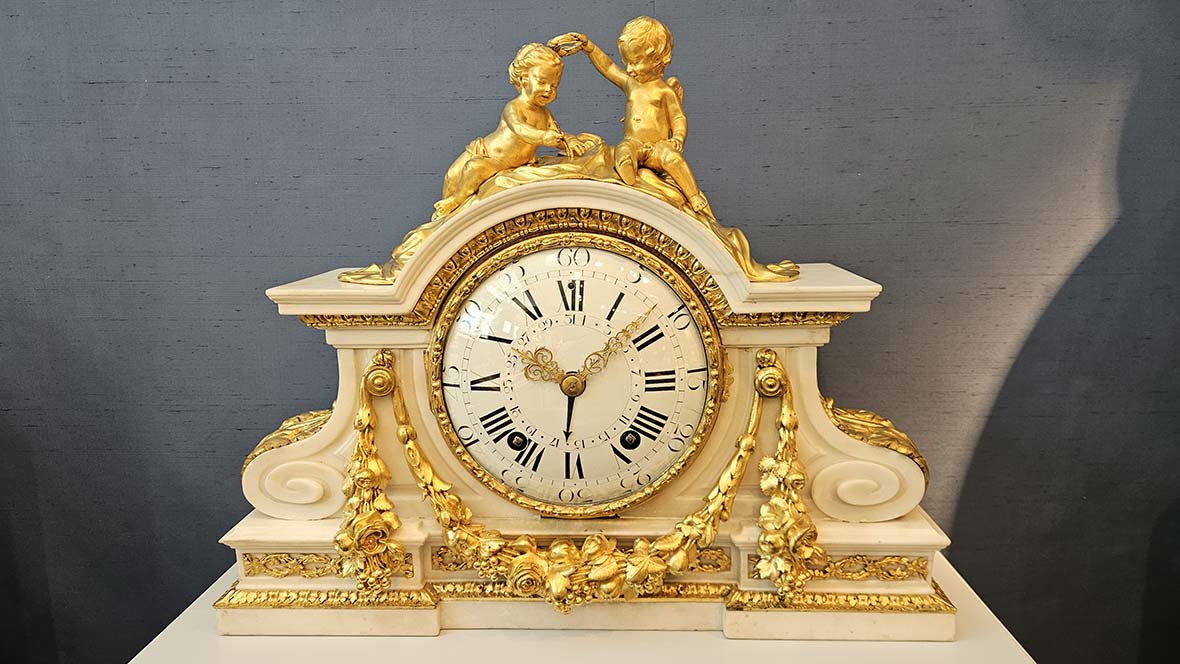
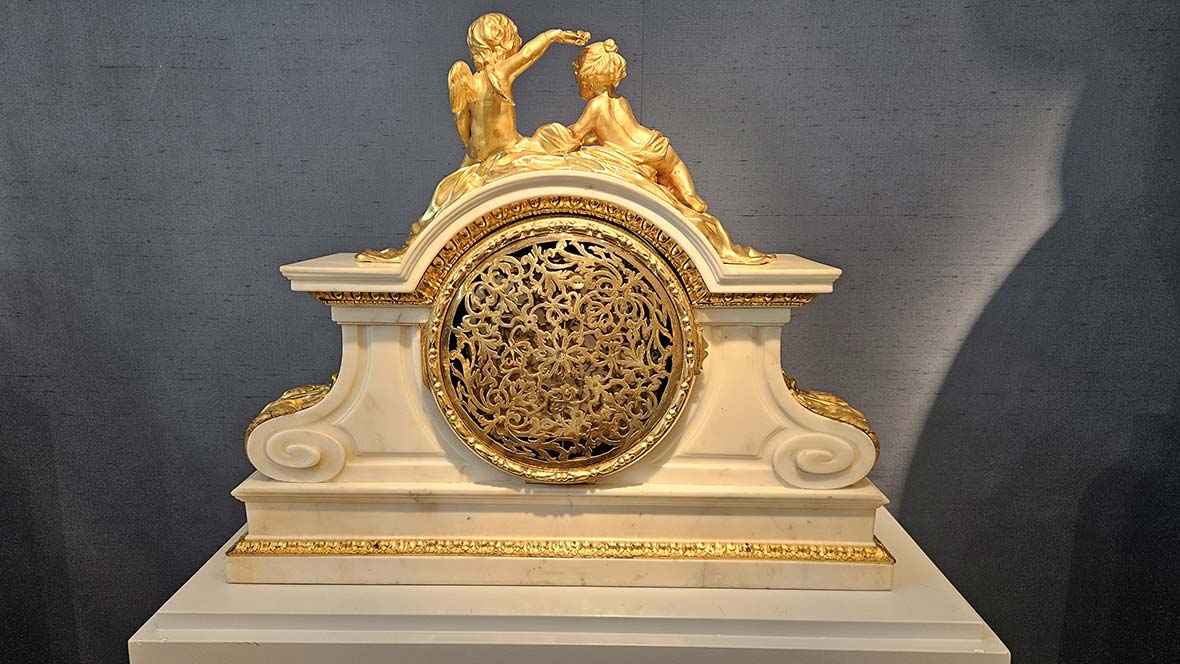
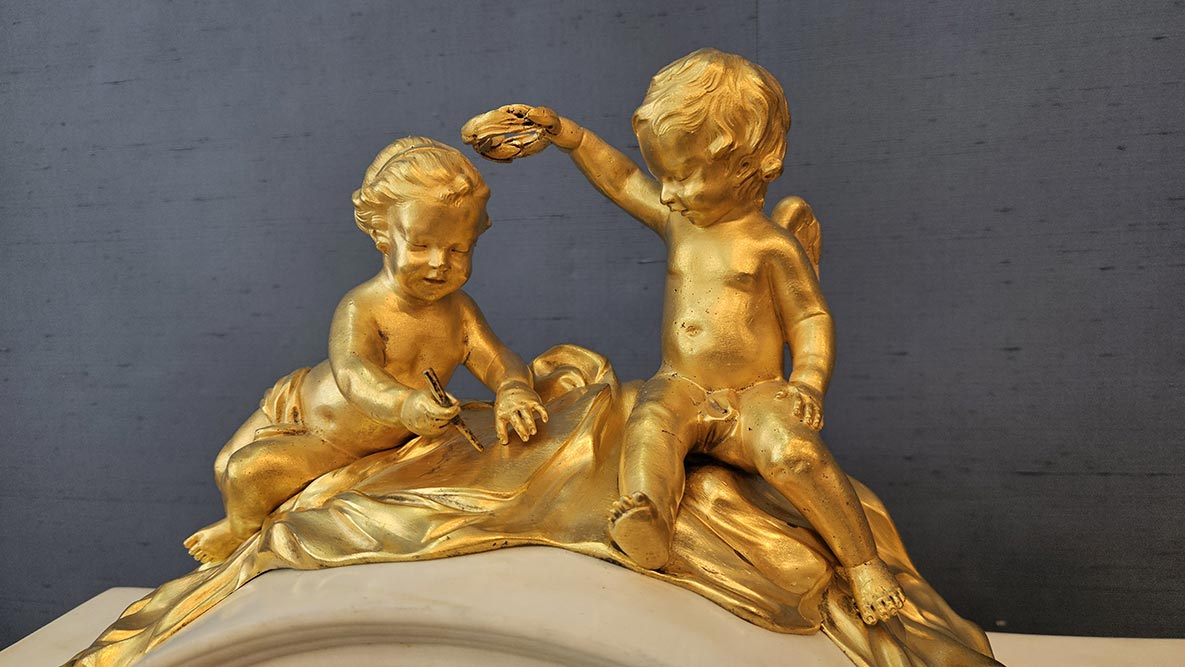
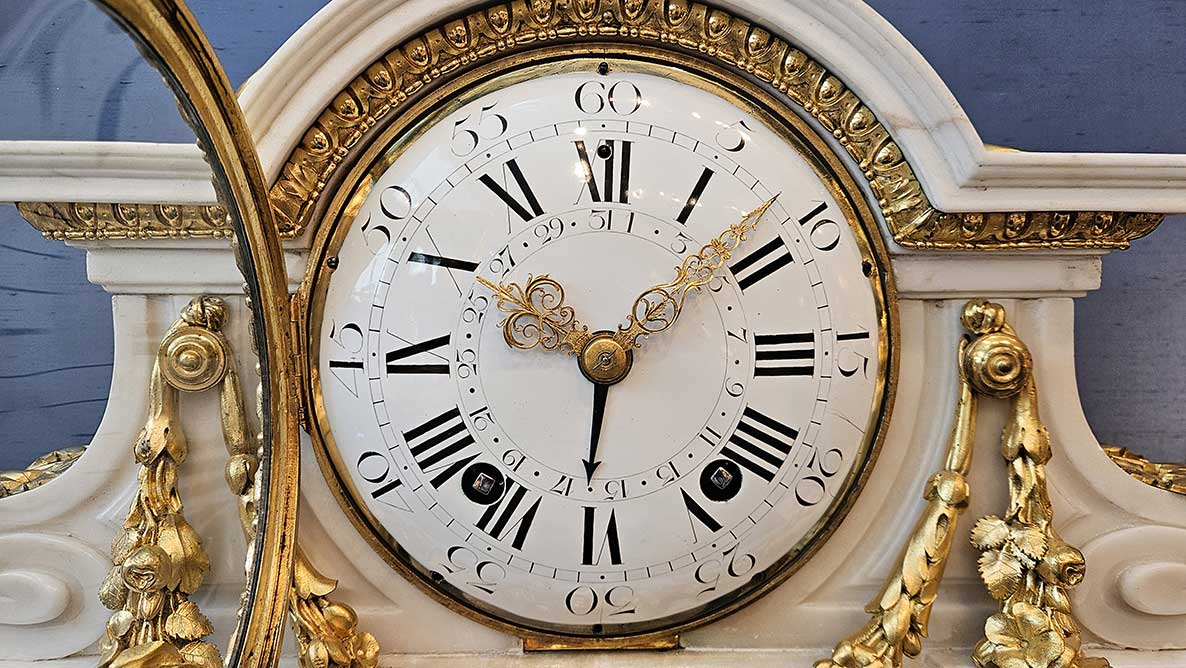
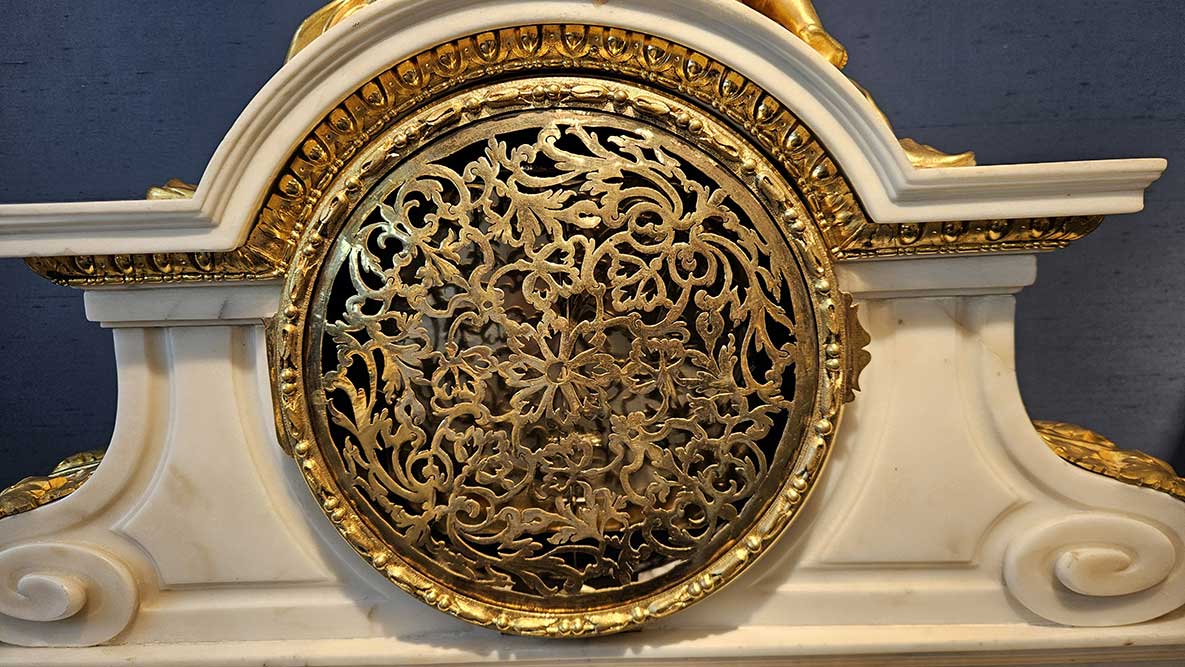
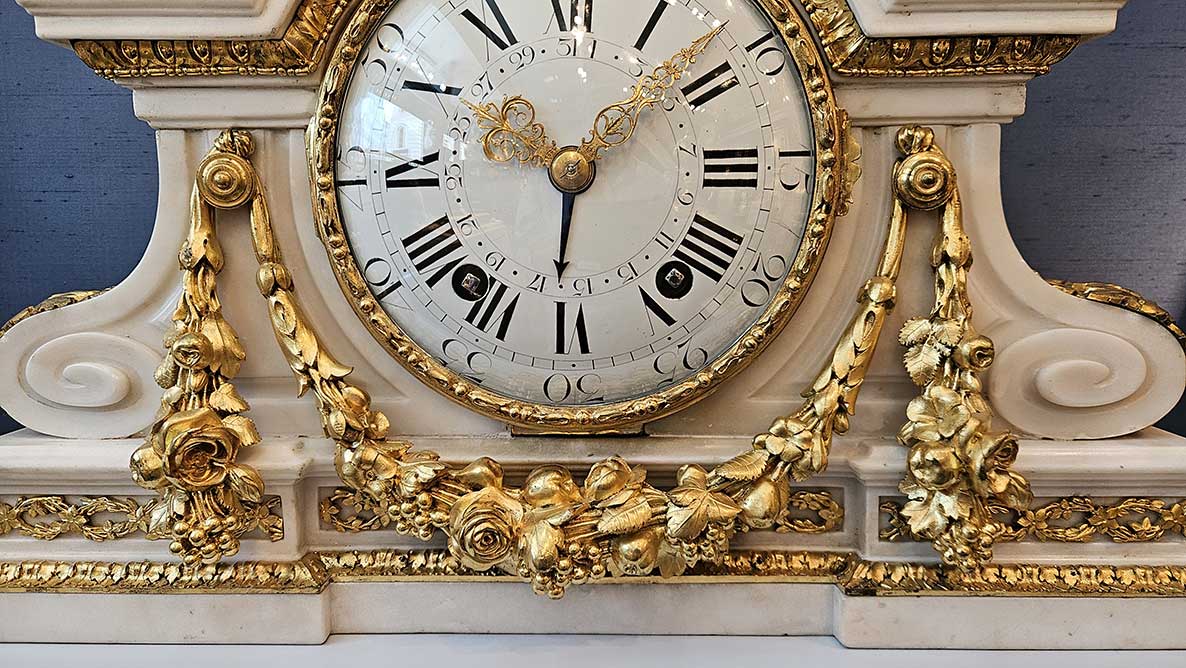
A Louis XVI gilt bronze-mounted white marble mantel clock
attributed to Robert Osmond – circa 1778
Robert Osmond (1711-1789), maître in 1746
Height: 45 cm. (17 ¾ in.) Width: 53.5 cm. (21 in.) Depth: 14.5 cm. (5 ¾ in.)
Provenance
Galerie Fabre, Paris
Comparatve Literature
H.Ottomeyer and P. Pröschel, Vergoldete Bronzen, Munich, 1986, vol. I, p. 229.
P.Verlet, Les Bronzes Dorées du XVIIIe Siècle, Paris, 1987, p. 117, fig. 148.
B.Rondot and J.-J. Gautier, Le château de Versailles raconte le Mobilier national: quatre siècles de création, Paris, 2011, pp. 153-155.
This model is a variation on a design by Robert Osmond preserved in the Institut national d’Histoire de l’Art in Paris (no. 77, ‘Piece a portail grande architecture avec 1 genie’, illustrated in Ottomeyer and Pröschel, op. cit., p. 229).
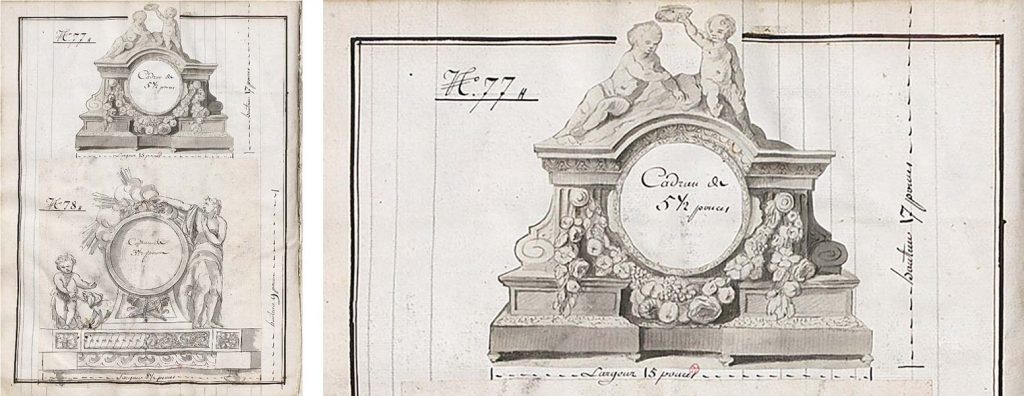
Recueil de desseins. Modèles de pendules, années 1755-1780, unnumbered page and detail of no. 77
Paris, Bibliothèque de l’Institut National d’Histoire de l’Art, collections Jacques Doucet (NUM MS 707)
By 1784 it had been moved to the large cabinet room of the Dauphin, then in his infancy, on the ground floor of the Princes’ Wing; later, on the eve of the French Revolution it was in the large study of his younger brother, the duc de Normandie, on the ground floor of the central section. Jean-Jacques Gautier has traced three more elaborate mantel clocks with additional putti supporting the arched pediment also amongst the pre-Revolutionary Royal Collections at Versailles, including one with a black marble plinth supplied to Louis XVI for the Cabinet de la Pendule (ibid., p. 154).
This collection of drawings was compiled with the intention of ascribing ownership of different models and thus protect their makers.
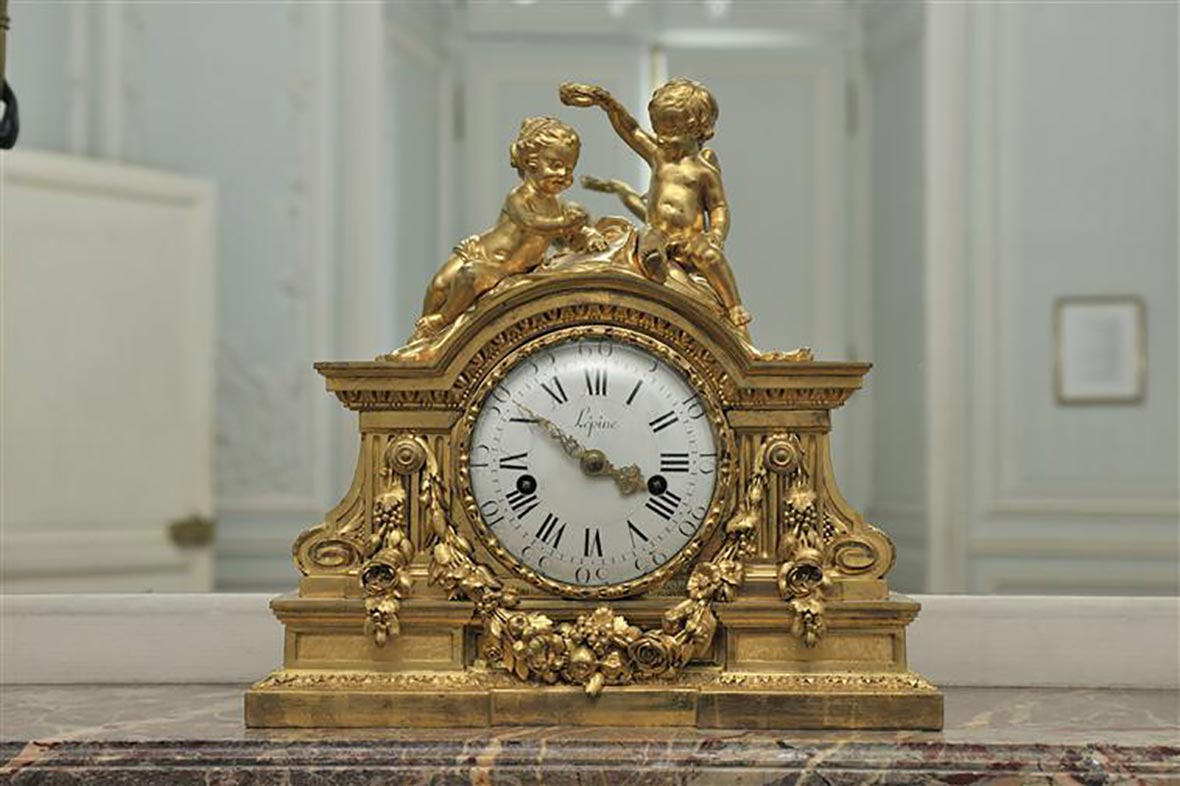
A smaller version all in gilt bronze which corresponds more closely to the design in its proportions and detailing is at Versailles (Rondot and Gautier, op. cit., pp. 153-155). This clock was supplied by the clockmaker Jean-Antoine Lépine in December 1778 for the apartment of Marie-Thérèse Charlotte (known as Madame Royale), the newly born first child of Louis XVI and Marie Antoinette. Surmounted with a winged genius crowning a studious female putto with a laurel wreath, it was clearly a considered choice for the princess’s rooms
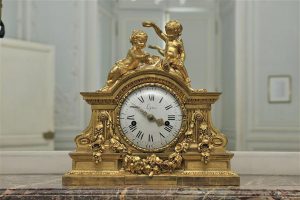
Louis XVI gilt bronze mantel clock, 1778
H 36.5 W 37.5 D 12.5 cm.
Versailles, musée national des châteaux de Versailles et de Trianon (GML 9491)
By 1784 it had been moved to the large cabinet room of the Dauphin, then in his infancy, on the ground floor of the Princes’ Wing; later, on the eve of the French Revolution it was in the large study of his younger brother, the duc de Normandie, on the ground floor of the central section. Jean-Jacques Gautier has traced three more elaborate mantel clocks with additional putti supporting the arched pediment also amongst the pre-Revolutionary Royal Collections at Versailles, including one with a black marble plinth supplied to Louis XVI for the Cabinet de la Pendule (ibid., p. 154).
Variations of the model were also used to adorn the tops of cartonniers and serre-papiers, an example of which is the one also all in gilt bronze and with the additional putti in the musée Jacquemart-André, Paris signed by Charles Le Roy (Rondot and Gautier, op. cit., p. 154 and Verlet, op. cit., fig. 148).
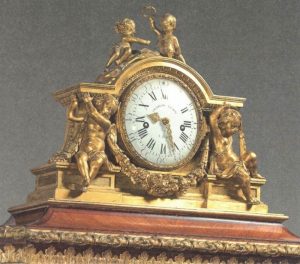
Louis XVI gilt bronze mantel clock
Paris, musée Jacquemart-André
A further example of this more simplified model, on a grey marble base was sold Christie’s New York, 19 March 1998, lot 157 ($43,700).